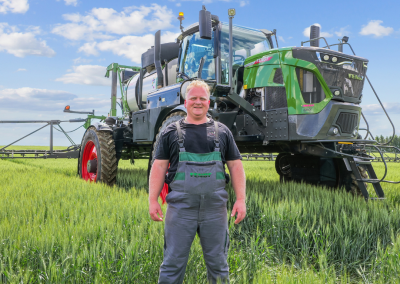
Faced with broad-spectrum weed pressure in potato fields, Eendracht Agro transitioned from conventional blanket spraying to drone-mapped precision application. By integrating RTK drone photography with BBLeap’s LeapBox technology, the grower isolated and treated only active weed zones, achieving an exceptional 94% reduction in herbicide inputs and a €2,106 direct cost saving on a single 5.4-hectare field without hindering crop growth.

Farm Facts
Eendracht Agro
Grower: Gerben Melissant
Location: Hoeksche Waard, The Netherlands
Main Crop: Potatoes
Total Farm Size: 320 hectares
Case Study Area: 5.4 hectares
Sprayer & Boom Width: John Deer R952i, (5200L, 39m boom width)
BBLeap Solution: LeapBox, LeapCat (Hi-Res spotspraying)
Application Focus: Weeds in a potato crop
The Challenge: The Inefficiencies of Blanket-Spraying Weed Infestations
Traditionally, managing weeds in potato crops meant uniform, full-field chemical applications. This broadcast approach resulted in high chemical costs, unnecessary environmental pressure, and the chemical exposure of healthy crops that did not require treatment. Blanket spraying the entire 5.4-hectare field to eliminate localized weed patches was both economically inefficient and agronomically sub-optimal.
The Innovation: RTK Drone Mapping & BBLeap LeapBox Precision Actuation
- RTK Drone Field Mapping: Gerben Melissant executes a brief 15-minute flight to capture roughly 2,500 high-resolution photos, which are compiled into a precise, stitch-mapped overview of the field to pinpoint exact weed locations.
- LeapBox Spot Spraying: The processed drone data is translated into a highly accurate prescription map. The BBLeap LeapBox system reads this data in real-time, activating individual nozzles only when passing directly over a mapped weed.
- Targeted Chemical Delivery: Instead of coating the entire field, the sprayer treats the weed zones with absolute precision, leaving the surrounding healthy potato crop completely untouched.
The scope of this data collection centered on a 5.4-hectare potato field treated with the herbicide Titus. By utilizing the BBLeap prescription map, the system successfully skipped the vast majority of the field area, confining active spraying to just 0.135 hectares.
| Crop Protection Input | Reference (Broadcast / Standard) | Field Reality (BBLeap Technology) |
|---|---|---|
|
Titus (Herbicide - 40 gr/ha) |
€ 40.00 / ha | € 40.00 / ha * |
| Total Cost per Hectare | € 40.00 / ha | € 40.00 / ha * |
| Total Input Investment (5.4 ha) | € 2,160.00 | € 54.00 * |
Breakdown (For 5.4 ha of Potatoes)
*Note: Field Reality costs are calculated based on the actual treated/sprayed area (0.135 ha).
Key Results at a Glance:
- Reduced Sprayed Area: Only 0.135 ha treated out of 5.4 ha (a 94% reduction in applied liquid volume).
- Financial Impact: A direct cash saving of € 2,106.00 on this single field alone.
- High-Efficiency Workflow: A short 15-minute drone flight has an impressive effect in cost and plant protection product savings, paving the way for cumulative savings.
“With one drone flight and some data analysis, I save an average of 250 euros per spray, which ultimately saves me 2,500 euros if I apply it to multiple plots.”– Gerben Melissant, Eendracht Agro
Agronomic Outlook & Future Potential
The success of this pilot in potatoes proves the immense scalability of the drone-to-LeapBox workflow across Eendracht Agro’s broader 320-hectare operation, which includes onions, beets, grass seed, and various wheats.
By expanding this technology to multiple plots, the farm projects overall herbicide savings of at least €2,500 across upcoming seasonal sprays. This methodology allows Eendracht Agro to easily hit stringent environmental compliance targets, drastically reduce its chemical footprint, and foster unhindered, homogeneous crop growth by sparing healthy plants from chemical stress.
Read more stories