


How Hannes Kuhnwald Turned an Older Sprayer into a High-Precision Machine
How Die in MV Agrar Dienste GmbH Maximizes EfficiencyHannes Kuhnwald manages a 600-hectare arable farm that showcases what is possible when deep agronomic knowledge meets high-resolution application technology. By adopting Excellent Spraying, Hannes proves that tailoring inputs to every single plant is not just an efficiency gain, but an essential step toward realizing the vision of Clean Food, Clean World.
“For a sprayer operator, this is truly a brilliant invention. My machine is from 2014, but right now, I can do everything that a brand-new modern sprayer can do.” – Hannes Kuhnwald

Farm Facts
Die in MV Agrar Dienste GmbH
Location: Mecklenburg-Vorpommern, Germany
Owners: Hannes Kuhnwald
BBLeap user since: 2023
Area: 10,000 ha
Crops: Winter wheat, winter barley, oilseed rape, grain maize, sunflowers, and hemp seed production (150 ha)
BBLeap features: LeapBox, LeapSpace, LeapMap
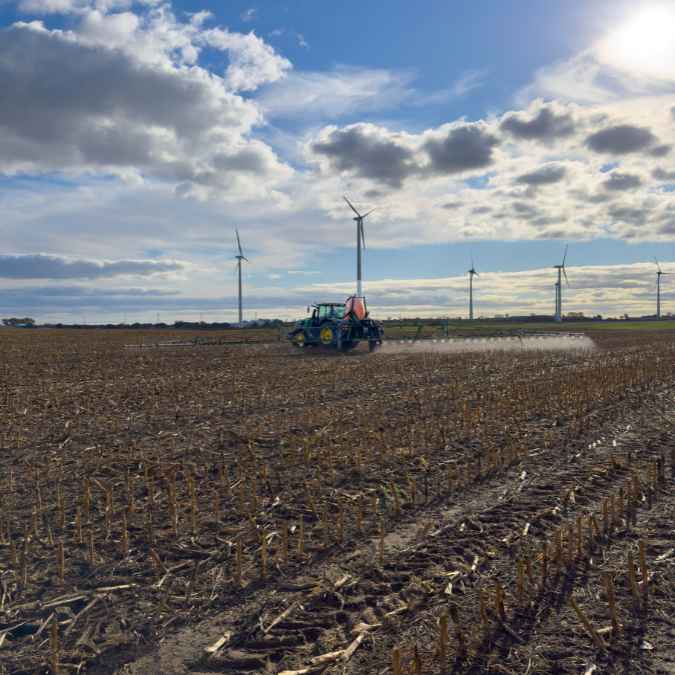
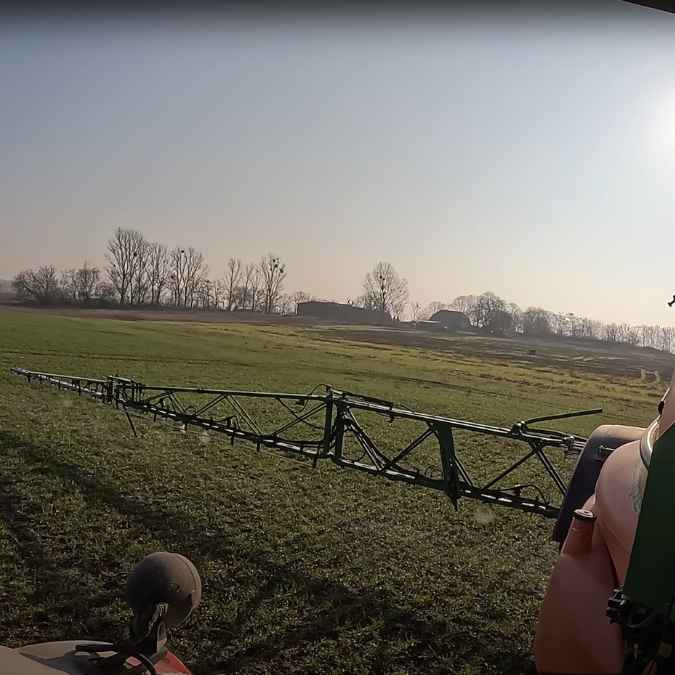
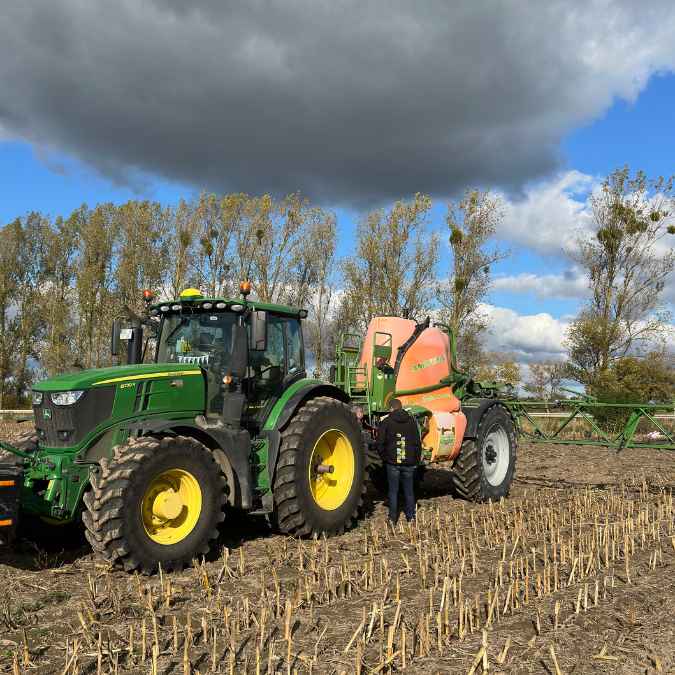
Sprayer: Amazone UX (2014), 27 m boom, 50 cm nozzle spacing
“Resistances almost always start along the borders, in curves, and wherever under-dosing occurs. We simply don’t have that anymore. Because we deliver 100% of the target dose everywhere, it works brilliantly.” – Hannes Kuhnwald
Every Drop Must Count
Sustainable agriculture is not about blanket treatments or field-wide compromises. On light soils in northeastern Germany, where low rainfall and early-summer droughts test crop resilience, every drop of water and nutrient must count. The vision of Clean Food, Clean World starts in the soil biology: feeding high-yielding zones to their genetic peak while cutting back on vulnerable, low-yield ground. By moving past coarse boom applications, Hannes protects surrounding natural biotopes, preserves soil health, and ensures clean crops enter the food supply chain.
Grounded in Agronomy
For Hannes, precision farming was never a marketing buzzword—it has been his focus for well over a decade. “I’ve been working on site-specific fertilization for a very long time. I wrote my bachelor’s thesis on it back in 2012 in Brandenburg, focusing on maize,” he shares. “On our farm, we started in 2009 with the Yara N-Sensor, and over time we expanded it so that virtually everything is managed site-specifically—fertilizer, digestate, and plant protection.”
Managing a diverse rotation that ranges from classic wheat, barley, and oilseed rape to specialty row crops like sunflowers and 150 hectares of hemp for seed production, he knew that sustainable no-till and minimal tillage depend entirely on targeted, precise application. Yet, while his agronomic theory and satellite/soil mapping were operating in high resolution, the technology behind the tractor was still tied to outdated mechanics.
The Cost of Coarse Hardware
The farm’s trusted workhorse was a mechanically sound, well-maintained 2014 Amazone UX trailed sprayer with a 27-meter boom. Mechanically, the boom, tank, and pump were in great condition, but application control was restricted to just nine 3-meter sections, lacking full modern ISOBUS variable-rate capabilities. The hardware bottlenecks:
The Averages Trap: With 3-meter sections across a 27-meter boom, high-resolution 5-meter or 10-meter prescription grids were forced to average out to whatever rate dominated the section. “If you had an application map on a 5-meter or 10-meter grid, the machine simply took the average of whatever zone was dominant,” Hannes recalls. “It was far too slow, and you could only represent one single broad zone. Nuanced maps were blunted into crude compromises.”
The Speed and Pressure Lag: In conventional pressure-governed systems, changing driving speed inevitably changes boom pressure. Starting from a dead stop, crawling out of field corners, or maneuvering around landscape features dropped or spiked the pressure. “You had that classic pressure drop where you always had too low an application rate, or droplets that were far too coarse until pressure finally caught up,” says Hannes. “You could see the consequences on the plants all year long—whether applying liquid fertilizer or herbicides.”
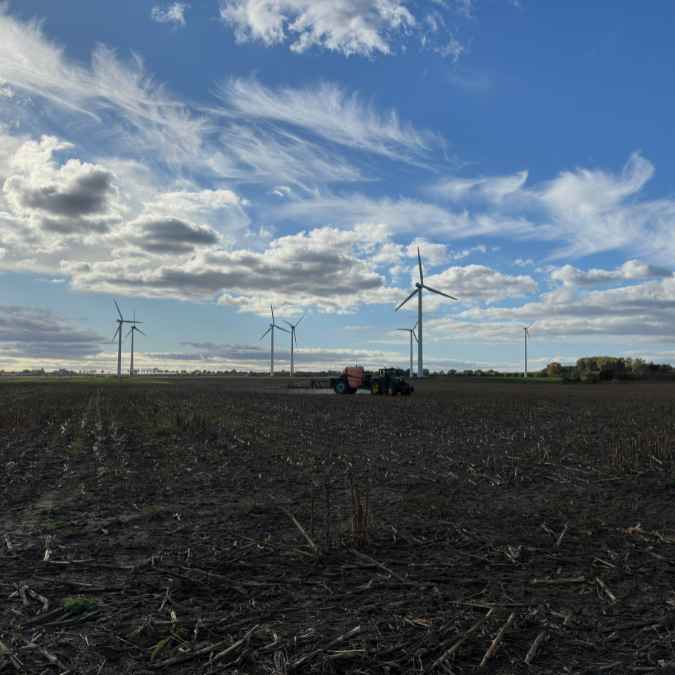
The Curve Penalty: The landscape in Mecklenburg-Vorpommern added to the challenge. “We have so many landscape elements—hedgerows, small ponds, wind turbines, and utility poles—where you are constantly driving curves,” says Hannes. “With the old setup, the inner boom crawled and overdosed, while the outside boom whipped around with too little volume. If you didn’t spray at 100% full rate, the outer curve was always the first spot where herbicides failed. It completely bothered me—it just wasn’t agriculture to perfection.”
Field Heterogeneity: Yield across fields swings wildly from 1–3 t/ha on sandy knolls (Sandkuppen) up to 10–12 t/ha in deep, moisture-holding soils. “My nitrogen strategy spans from 50 kg N up to 250 kg N. In recent years, I only feed high-yield zones 4 and 5, and cut off application on poor ground,” Hannes points out. “Jumping from 150 liters down to 10 or 20 liters just wasn’t possible before. To make low rates work at all, I had to drive at crazy, extreme speeds. It was completely unsatisfactory.” He needed a system that could deliver huge dynamic rate changes while locking pressure strictly at 2.0 bar to prevent fertilizer scorch on the leaves.
State-of-the-Art Spray Tech Without Crushing CapEx
The market alternative offered little logic. In the wake of post-COVID machinery inflation, replacing his reliable Amazone with a factory-PWM machine carried an unrealistic price tag. “What used to be a €60,000 sprayer had somehow turned into €140,000, and with factory PWM you’re easily looking at €180,000. Who is supposed to earn that back? My boom was fine, the tank was fine, and the pump was serviced. I wanted to future-proof my machine without spending that kind of money.”
His requirement was clear: an affordable, high-frequency pulsing system that could retrofit onto his existing boom, integrate directly into ISOBUS, and provide individual nozzle shut-off and curve compensation without replacing the entire machine.
LeapBox Retrofit for a Proven Machine
The turning point came when Hannes decided to retrofit his 2014 Amazone UX with BBLeap’s LeapBox technology.
Instead of 9 broad sections, the retrofit converted the 27-meter boom into 54 virtual sections at 50 cm nozzle spacing, instantly decoupling droplet size and application rate from driving speed. Working pressure remains constant at the operator-selected target, while rate is modulated in milliseconds via high-frequency pulses.
“That means I can adapt to 10 or 12 transition zones seamlessly. The system is so much more dynamic than before,” Hannes says. Turn compensation is handled automatically: whether maneuvering around obstacles at 6 km/h or cruising open flats at 20 km/h, every plant receives its intended target rate.
“I can even tell the system to use boundary nozzles behind the tractor wheels so I don’t spray bare tramline soil, which saves roughly 4% on fungicides alone,” Hannes adds. “I started by trimming chemicals by 5 to 10%. Today, combined with water conditioning, I’ve reduced certain products by up to 50%, and for herbicides I run at a maximum of 90% dose with equal or even better efficacy.”
“With other systems capped at only 20 Hz, if you apply 20 liters you get a checkerboard skipping pattern as speeds change. BBLeap pulses up to 100 times per second—the pulses are so fast and the spray spots so small that you get zero checkerboarding. The adjustment is completely seamless.” – Hannes Kuhnwald

Proof Across 10,000 Hectares
When Hannes first announced the retrofit, fellow farmers warned him that PWM caused skips and unreliability. After treating over 10,000 hectares, the operational results proved the value of BBLeap’s high-frequency architecture:
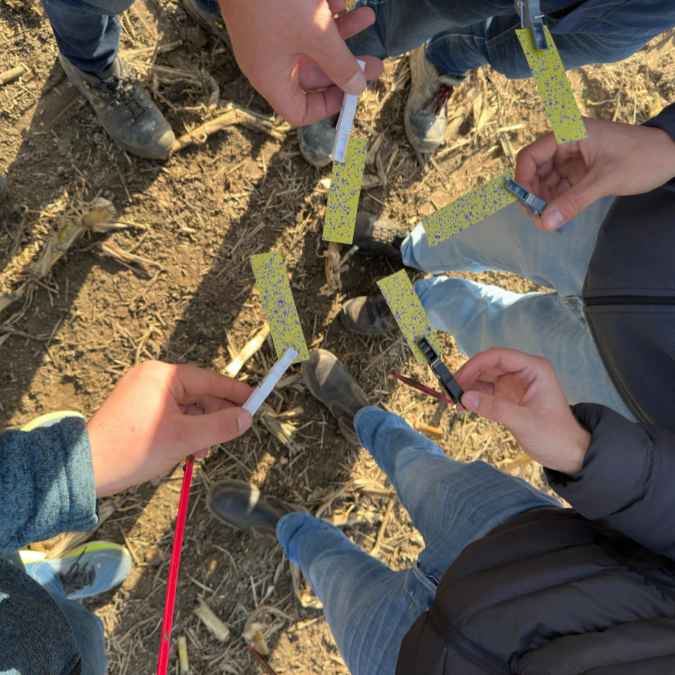
100 Hz Pulsing: While competitor systems running at 10–20 Hz leave visible gaps and checkerboarding at high speeds and low doses, BBLeap’s 100 Hz frequency keeps coverage continuous and completely uniform.
One Single Nozzle & Zero Scorch: “I now run an ultra-coarse 012 nozzle for everything. Early in the season I apply 300 to 400 l/ha, and in the final pass I drop down to 20 l/ha with that exact same nozzle,” Hannes explains. “I set a limit of 2.0 bar, and it never exceeds it. That is critical with liquid nitrogen to avoid scorch.”
Curve Compensation: With real-time curve compensation across 54 independent sections, turns around posts and hedgerows no longer produce growth restraints on the inside or diseases on the outside.
Wider Weather Windows: Running coarse nozzles without tip filters or pre-filters—relying solely on a single fine pressure filter—ended nozzle clogging entirely. Furthermore, Hannes can now actively manage drift on the fly: starting at 3.0 bar with coarse drops when there is a breeze in the evening, and stepping up to 4.0 or 5.0 bar right from the screen as the wind dies down.
“I brought the sprayer out of winter storage, hooked it up to the CCI 1200 terminal, climbed in, and drove off. It works. It works. It works. Just like that. As a sprayer operator, you normally spend all year dealing with nozzle turning and clogged nozzles—with this system, that’s completely gone.” – Hannes Kuhnwald
Drones, Spot Spraying, and Mobile Assets
With a 50 cm grid already installed, Hannes’s 2014 machine is ready for drone mapping and camera-guided precision spraying. “Using a drone is simply the fastest and best method, and with our 50 cm resolution, we’re perfectly prepared for it,” he notes.
Best of all, Hannes has completely decoupled his spraying technology from the machine’s depreciation. “If I were ever to buy another sprayer, I’d probably purchase a solid used machine and transfer the BBLeap system to it,” Hannes explains. “The old sprayer can easily be converted back to the original diaphragm valves and resold. Or I could order a brand-new sprayer in the basic configuration with just one section and install BBLeap on it. Why pay huge OEM markups when you can have this?”



“I Am Extremely Satisfied”
Having operated the system across 10,000 hectares of demanding fieldwork, Hannes Kuhnwald leaves no doubt about his verdict:
“I originally went into this thinking, ‘Okay, let’s see how it improves the application,’ but there were so many benefits I never even anticipated. Bringing it out of winter storage, zero clogged nozzles, perfect distribution across every curve… After 10,000 hectares, I am extremely satisfied. I honestly cannot put it any other way.” – Hannes Kuhnwald
Read more stories
Cost Reduction in Red Onions Using Row Spraying | Beuling Farm
