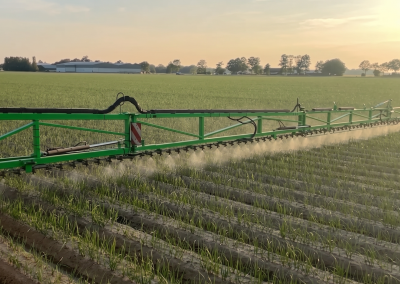
By using drone imagery and the BBLeap system, grower Pieter applied variable-rate chemical doses down to a 25 x 25cm resolution, completely skipping dead haulm and scaling active rates based on plant biomass. This targeted approach reduced total chemical and liquid volumes by 30%, lowering per-hectare input costs from €72 to €52 and saving €151 on a 7-hectare field. Expanding this plant-specific technique across the full 36-hectare farm demonstrates a highly efficient, sustainable, and future-proof crop protection strategy.
Farm Facts
Maatschap van Leeuwen Boomkamp
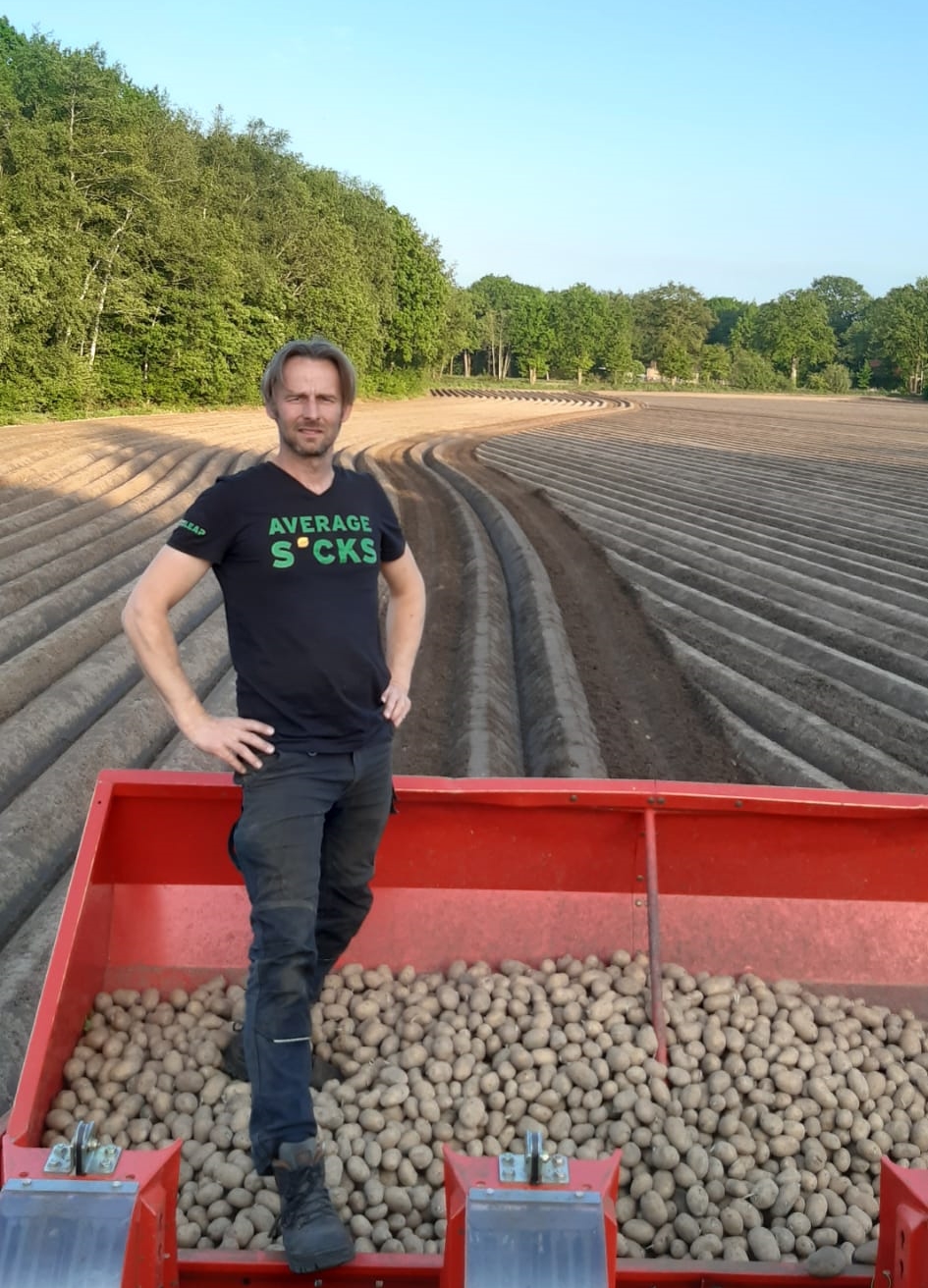
Grower: Pieter van Leeuwen Boomkamp
Location: Nijkerk, The Netherlands
Main Crop: Potatoes
Total Farm Size: 160 hectares with a total of 36 hectares potatoes
Case Study Area: 7 hectares of potatoes
Sprayer & Boom Width: Fendt Rogator 366 (6600L, 36m boom width)
BBLeap Solution: LeapBox, LeapSpace, LeapMap
Application Focus: Potato haulm killing
The Challenge: Prevent wasting herbicides in potato haulm killing
Timing and precision are everything when preparing a potato crop for harvest. To ensure tubers develop strong, durable skins that prevent damage and rot during harvest and storage, the potato haulm needs to be killed at the exact right moment. In seed potato production, this process is equally critical to stop growth and lock in the ideal tuber size.
Traditional broadacre spraying often struggles in these conditions. As plants begin to die off naturally, standard spraying results in product landing on bare soil or on plants that no longer need it. At the same time, vibrant green plants require a higher dosage, while weaker or smaller plants need significantly less.
The Innovation: Spray at plant specific needs
With the BBLeap system, Pieter was able to vary the dosage per nozzle every 25 x 25 cm to provide plants with exactly what they need:
- LeapMap: High-resolution task map spraying with the ability to apply a different application rate every 25 x 25 cm.
- LeapSpace: The task map created in software using drone imagery integrates seamlessly with LeapSpace—no USB sticks are needed to get the task map into the tractor.
- Excellent Spraying: Always provides the right droplet size, application rate, and distribution while maintaining Excellent Spraying performance, even when precision-spraying specific spots.
Input Reduction & Financial Savings
The field was divided into four management zones based on foliage biomass. A zero-rate (0.0 L/ha) zone was assigned to areas where the potato haulm was already completely dead. The maximum advised dosage of 0.8 L/ha was applied to the highest biomass zone, while the lowest biomass zone received 0.2 L/ha. In contrast, a conventional broadcast treatment would have sprayed the entire field at the maximum 0.8 L/ha rate. Water application rates for the treated zones varied between 100 L/ha and 400 L/ha. Because the already dead potato haulm was not sprayed, only 6.7 of 7 hectares needed to be sprayed. The average applied dosage of Quickdown on the field was 0.59 L/ha.
| Crop Protection Input | Reference (Broadcast / Standard) | Field Reality (BBLeap Technology) |
|---|---|---|
|
Quickdown (0.8 L/ha) |
€ 52.00 / ha | € 38.03 / ha * |
|
Oil (2 L/ha) |
€ 20.00 / ha | € 14.63 / ha * |
| Total Cost per Hectare | € 72.00 / ha | € 52.66 / ha * |
| Total Input Investment (7 ha) | € 504.00 | € 352.82 * |
* Note: Field Reality costs are calculated based on the actual treated/sprayed area (6.7 ha).
Key Results at a Glance:
- Reduced Sprayed Area: Only 0.135 ha treated out of 5.4 ha (a 94% reduction in applied liquid volume).
- Financial Impact: A direct cash saving of € 2,106.00 on this single field alone.
- High-Efficiency Workflow: A short 15-minute drone flight has an impressive effect in cost and plant protection product savings, paving the way for cumulative savings.
Agronomic Outlook & Future Potential
Potential cost and volume savings depend on the specific crop variety, but reducing inputs and liquid volumes by 30% is well within reach across the entire 36-hectare field. By plant specific spray applications to the exact needs of individual plants, this targeted approach offers a sustainable, future-proof method for managing crop chemicals.
Read more stories
Herbicide Reduction in Potatoes via Spot Spraying | Eendracht Agro