




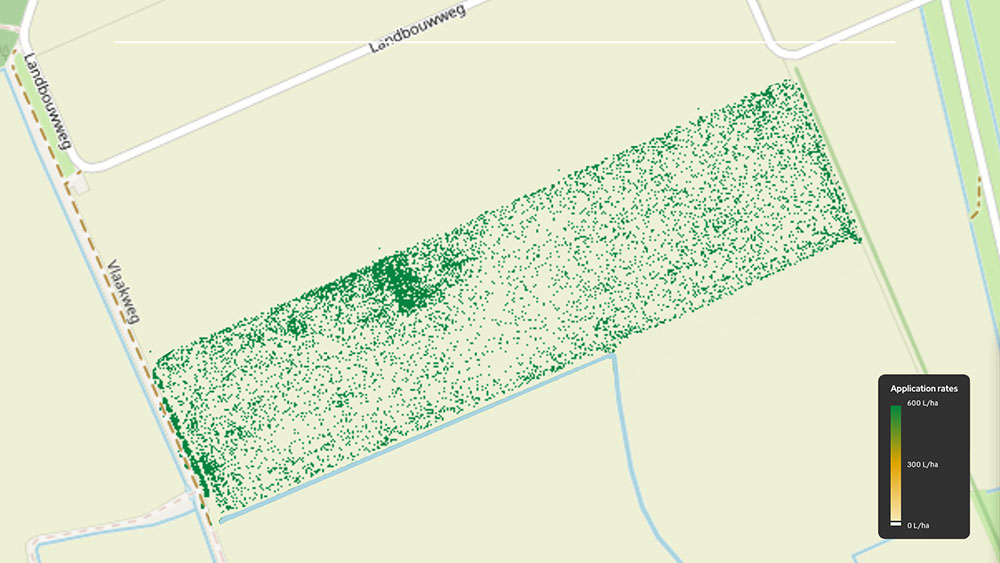
Spraying with prescription maps offers far greater precision, efficiency, and effectiveness than traditional uniform rate spraying. By using data to create a detailed application plan, you ensure every part of your field receives exactly what it needs—no more, no less—leading to significant chemical savings and healthier crops. This approach moves beyond averages to enable true plant-level care. Read the overview article about using prescription maps on a sprayer
How does variable rate spraying with prescription maps differ from fixed-rate spraying?
Variable rate spraying with prescription maps targets specific field areas with precise, data-driven dosages, whereas fixed-rate spraying applies one single rate across the entire field. This fundamental difference allows you to optimize inputs, reduce waste, and improve crop performance by treating field variability instead of ignoring it. With our LeapBox system, you can execute these maps with unparalleled accuracy.
The main advantage of using prescription maps is the ability to manage your fields at a granular level. Instead of treating the whole field as one unit, you can address variations in soil type, weed pressure, or crop health. This targeted approach not only reduces chemical usage, with savings up to 99% in spot-spraying scenarios, but also prevents crop damage from overdosing and yield loss from underdosing. While a uniform application is simpler to execute, it inevitably leads to inefficiency and suboptimal results.
Below is a direct comparison of the two approaches:
| Feature | Variable Rate Spraying (with Prescription Map) | Uniform / Fixed-Rate Spraying (Manual) |
|---|---|---|
| Precision | High precision, targeting zones or even individual plants. With our system, you can achieve a resolution down to 25×25 cm. | Low precision, applies a single average rate across the entire field, regardless of in-field variation. |
| Chemical Use | Optimized and significantly reduced. You only apply what is needed, where it is needed. | Inefficient, leading to over-application in some areas and under-application in others. |
| Crop Health | Improved, as crops receive the correct dosage, minimizing stress and maximizing growth potential. | Compromised, with risks of crop burning from overdosing and disease from underdosing. |
| Environmental Impact | Lowered due to reduced chemical runoff and minimized use of resources. | Higher due to excessive and untargeted chemical application. |
| Efficiency & Speed | Field efficiency is maximized. Our LeapBox system adjusts rates at 100Hz, ensuring perfect application without slowing down. | Simple to operate, but overall field efficiency is low due to wasted inputs and suboptimal results. |
In what situations might manual uniform applications still be preferable?
Manual uniform applications might only be considered for perfectly homogenous fields with no variability or for very low-value treatments where the cost of data collection outweighs potential savings. However, as technology advances and data becomes more accessible, these situations are increasingly rare. The precision and savings offered by prescription map spraying make it the superior choice for modern, progressive farming.
How do different types of prescription maps for a sprayer compare?
Different prescription maps, such as zone-based, high-resolution grid, and spot-spraying maps, offer distinct levels of precision tailored to specific agricultural goals. Zone maps are best for managing larger, relatively uniform blocks within a field, while high-resolution grid and spot-spraying maps enable true plant-level management for maximum efficiency and savings. Our LeapBox system is designed to execute all these map types flawlessly.
Choosing the right map depends on your objective. A spot-spraying map, for example, is binary—it tells the sprayer to turn on or off—which is perfect for targeting isolated weeds and can reduce herbicide use by up to 99%. A continuous rate map, like a grid or zone map, varies the dosage across the field to manage nutrient deficiencies or disease pressure. We excel at executing high-resolution maps, allowing for treatment on a 25×25 cm grid for ultimate precision.
| Map Type | Resolution | Best Use Case | Agronomic Goal |
|---|---|---|---|
| Zone-based Map | Coarse (e.g., 2-5 large zones per field) | Fields with clear, large areas of variation, like different soil types or consistent yield patterns. | Applying different base rates of fertilizer or soil conditioners to large management zones. |
| High-Resolution Grid Map | Fine (e.g., 25×25 cm with BBLeap) | Variable rate application of nutrients, fungicides, or growth regulators based on detailed drone or satellite imagery. | Precisely matching input to crop need at a near-plant level to maximize yield and uniformity. |
| Spot-Spraying Map | Binary (On/Off per nozzle) | Targeting specific, individual weeds or problem spots identified by aerial imaging or ground scouting. | Drastically reducing herbicide costs and minimizing chemical impact on the crop and environment. |
What criteria should you use to choose a provider for sprayer prescription maps?
When selecting a software or data provider for prescription maps, you should prioritize technical compatibility with your sprayer, the agronomic validity of their data, and seamless platform integration. The right partner ensures that the high-quality data from the map is perfectly translated into action by the nozzles in the field. Our LeapSpace platform is designed for this, integrating easily with leading data providers.
A great map is useless if your sprayer can’t execute it properly. That’s why evaluating the entire workflow, from data acquisition to final application, is critical. Look for providers who understand both the agronomy and the technology, ensuring their maps are not only accurate but also practical to implement with your equipment.
How should you evaluate a prescription map provider?
- Technical Compatibility: Does the provider’s platform export maps in a format your terminal can read? Do they offer wireless data transfer, like our LeapSpace platform, to avoid the hassle of USB sticks? Can their system generate maps at the high resolution your sprayer can handle, such as our 25×25 cm capability?
- Agronomic Quality: What data sources are used (satellite, drone, soil scans)? Is the advice based on proven agronomic models? Can you customize recommendations based on your own knowledge of the fields?
- Platform Integration and Support: Does the provider have established partnerships with hardware manufacturers and other software? Is the platform user-friendly? What level of customer support is offered if you run into issues creating or uploading a map?
- Data Feedback Loop: Can the platform receive “as-applied” data back from the sprayer? This is crucial for record-keeping, evaluating performance, and refining your strategy for the next season.
Conclusion
Comparing variable rate spraying to uniform application reveals a clear winner for modern agriculture. By leveraging prescription maps, you move away from wasteful averages and embrace precision, efficiency, and sustainability. Whether you use zone, grid, or spot-spraying maps, the ability to apply the right amount in the right place is transformative. With us, you get a system built on the principle of “No compromises, no averages,” ensuring your sprayer can execute any task map with plant-level accuracy.