




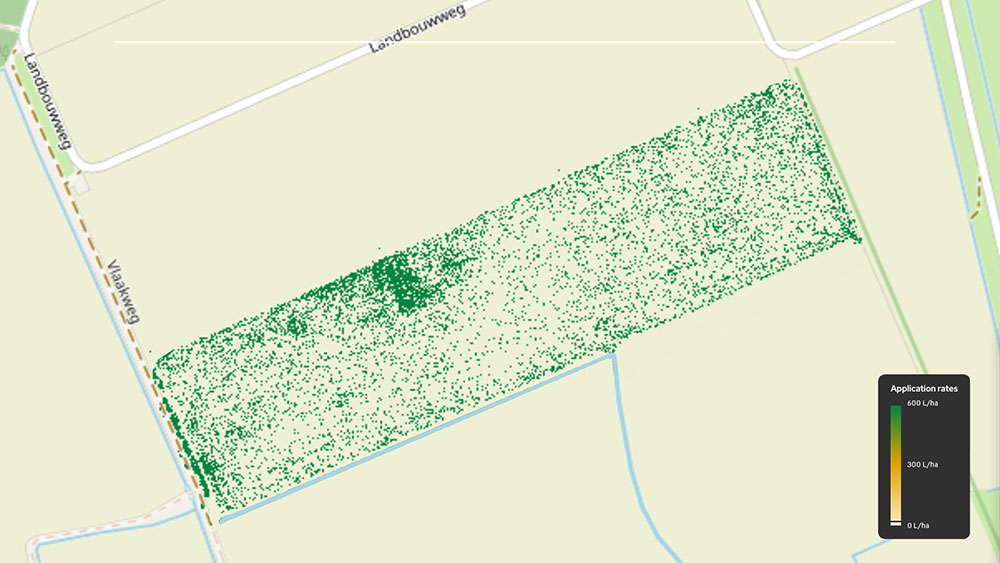
Using prescription maps on a sprayer connects a georeferenced application plan to nozzle-level control, allowing the machine to automatically vary rates as it moves through the field. With our LeapBox system and LeapSpace platform, you can execute high-resolution taskmaps down to a 25×25 cm grid. This technology lets you spray exactly what is needed, where it is needed, while maintaining optimal pressure and droplet size across broadacre crops, row crops, and orchards.
Who is responsible for each part of the process?
Variable rate spraying involves several partners and technologies working together. The table below shows a typical workflow, clarifying who does what.
| Step | What it produces | Who does it | BBLeap’s part |
|---|---|---|---|
| 1. Map Creation | A prescription map file (taskmap) | The grower, crop advisor, or a drone/satellite data provider | BBLeap works with data provider partners; confirm the map format and configuration needed for your application. |
| 2. Map Transfer & Storage | Map sent to the sprayer; as-applied data sent back | A farm management software platform | Our LeapSpace platform handles cloud-based transfer and storage, eliminating the need for USB sticks. |
| 3. Execution on the Boom | Varied application rate per nozzle | The sprayer’s rate controller | The LeapBox system executes the map’s instructions with 25×25 cm precision. |
| 4. Driving & Agronomic Judgment | The physical spray application | The grower or contractor | BBLeap provides the enabling technology; the operator manages the fieldwork. |
What does it mean to use prescription maps on a sprayer for variable rate spraying?
Using a prescription map, or taskmap, means the sprayer automatically follows a pre-made plan that assigns a specific dose to every location in the field. As the sprayer moves, its GPS position is used to tell each nozzle when to open, close, or change its rate. The LeapBox system uses variable-frequency and duty-cycle control at up to 100 Hz per nozzle while maintaining constant pressure and droplet size for optimal application. All taskmaps and as-applied maps are managed in the cloud via LeapSpace, providing a complete record of your work. Read the in-depth explanation of prescription maps on sprayers
What is the difference between taskmap spraying and real-time camera spraying?
Taskmap spraying and real-time camera spraying are two different ways to achieve variable rate application. Taskmap spraying uses a pre-made prescription map based on data from sources like drones or soil scans; you create the plan first and then execute it. Real-time spraying uses cameras mounted on the boom to detect weeds or crop characteristics and spray them instantly in a single pass. A taskmap approach is ideal for addressing known, mapped variability, while real-time systems are built for immediate, on-the-go detection and response.
How do I arrange for variable rate spraying on my sprayer?
Start by checking the complete map-to-machine workflow and discussing the configuration before purchasing or installing equipment:
- Check your sprayer and intended application. Confirm the terminal, rate controller, nozzle control and supported map formats with your supplier. Section switching alone does not establish variable-rate map capability.
- Choose a map source. You or your crop advisor may create a compatible map, or you can explore BBLeap’s data provider partners.
- Discuss configuration and obtain a quote. Use the configurator to explore a personalized setup and confirm compatibility, included equipment and installation arrangements before purchase.
- Ask about a demonstration. Contact BBLeap to discuss availability, location and any charges.
- Arrange installation and test the workflow. Once the configuration and quote are agreed, confirm installation and training arrangements, then test map transfer and execution before relying on the setup for a full application.
What options exist for using prescription maps on a sprayer in terms of capabilities and supported applications?
Our systems allow you to begin with simple zone-based variable rates and advance to plant-level precision. In broadacre crops, Taskmap Spraying enables you to vary rates for herbicides, fungicides, and fertilizers across management zones or on a 25×25 cm grid. For targeted weed control, Hi-Res Spot Spraying uses detailed maps to treat only specific plants, reducing chemical use by up to 99%. In orchards, taskmap spraying can vary rates per tree, while Tree Profile Spraying supports differences within the tree profile. Row & Pattern Spraying adds treatment on crop rows, between rows, or in configured patterns. Explore capabilities and application options for prescription map spraying
What are the main steps to create and use a prescription map on a sprayer from start to finish?
The workflow moves from data collection to precise execution. It starts with gathering field data from yield maps, soil samples, or satellite and drone imagery. An orchard example is tree data collected by a TreeScout system, which scans trees while mounted on a tractor and uploads the data for use in a taskmap. An advisor or platform turns this data into a taskmap file with target rates. You then upload this map to LeapSpace, which sends it to the LeapBox on your sprayer via its 4G connection—no USB sticks required. In the cabin, you select the task and begin spraying. During the job, an as-applied map is logged back to LeapSpace for your records. See the step-by-step workflow for creating and using prescription maps
How do different approaches to using prescription maps on a sprayer compare to manual or uniform rate spraying?
Prescription maps let an operator plan location-specific application rates rather than use one rate across the whole field. LeapBox varies output per nozzle, and Curve Control compensates for nozzle speed differences during turns. The value of a mapped application depends on the treatment need, the prescription, calibration and operating conditions. Uniform rates can remain suitable where the intended treatment is uniform; a variable map does not guarantee lower costs or better crop results in every field. Compare prescription map spraying with uniform and manual spraying
In which farming situations is it most beneficial to use prescription maps on a sprayer?
Prescription maps may be useful where measured differences in fields or crops call for different treatment rates. Taskmaps are highly effective in broadacre crops like cereals and potatoes for tailoring herbicides or growth regulators to soil zones or weed pressure. In row crops, they allow precise targeting of rows or individual weeds. For orchards and vineyards, they help match spray rates to tree size and canopy density, reducing waste. Assess the likely treatment savings alongside mapping, equipment and operating costs for your own farm; acreage or crop value alone does not establish a return on investment. Discover when prescription maps on sprayers make the most sense
What results can growers realistically expect from using prescription maps on a sprayer?
The result depends on the application, the quality of the prescription and the configured sprayer. BBLeap describes chemical-use reductions of up to 99% for suitable Hi-Res Spot Spraying treatments, where mapped targets allow much of the field to remain untreated. This treatment-specific upper bound is not an expected saving for every prescription map. Review the as-applied data and the actual crop and input results for your own application; neither a particular saving nor a yield increase is guaranteed. Learn more about results, risks and proof from prescription map spraying