




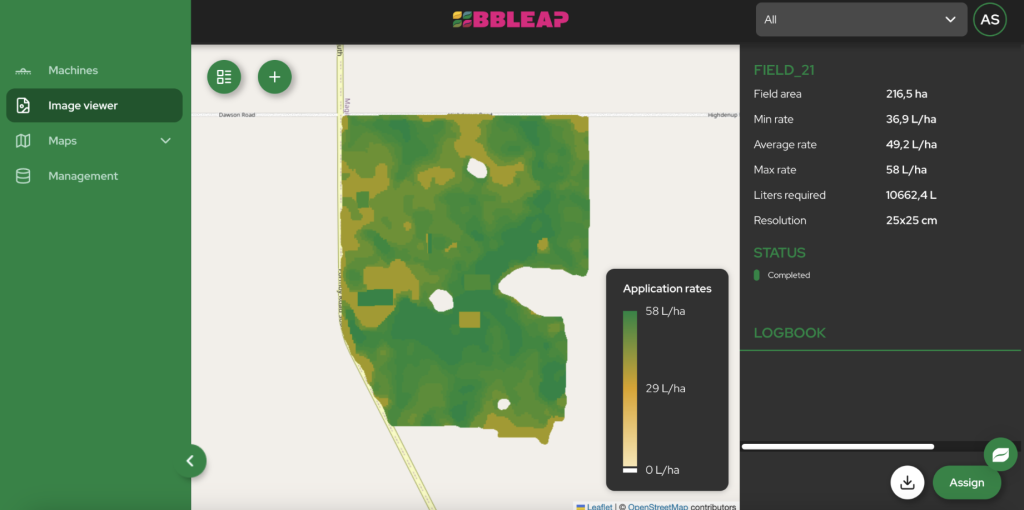
Using prescription maps on your sprayer allows you to achieve significant, measurable results, including reduced chemical usage, lower costs, and healthier, more uniform crops. By moving away from average-rate applications and applying inputs only where they are needed, you gain precise control over your fieldwork. Our technology is designed to turn the data from your maps into real-world success. Read the overview article about Use prescription maps on a sprayer
What measurable improvements can be achieved by using prescription maps on a sprayer?
You can achieve significant chemical savings, more stable and potentially higher yields, and clear environmental benefits by applying inputs precisely where they are needed. Instead of treating an entire field uniformly, prescription maps allow our system to target specific zones or even individual plants, which optimizes resource use and improves overall field performance.
What ranges of chemical savings are typically reported?
With high-resolution spot spraying based on task maps, savings can be as high as 99%. More broadly, growers using our technology for variable-rate applications often see a reduction in overall chemical use by up to 30%. For example, one of our clients, Timmermans Agri-Service, used a task map to treat dock in grassland and reported that 96% of their crops remained untouched by the herbicide, preventing growth hindrance and saving significant costs.
How can using prescription maps affect yield stability?
Prescription maps improve yield stability by eliminating the risks of over- and under-dosing. Uniform application can stress crops in some areas (too much chemical) while leaving them vulnerable in others (too little). By delivering the exact required dosage everywhere, you create a more consistent growing environment, which reduces crop stress and supports more uniform development. This precision can lead to yield increases of up to 20%.
In what ways can prescription maps contribute to environmental benefits?
The primary environmental benefit comes from drastically reducing the total volume of chemicals applied to a field. By spraying only where necessary, you minimize the risk of runoff into waterways and reduce the overall chemical load on the environment. This precision also helps in reducing spray drift, as the application is targeted and controlled, ensuring inputs stay where they are intended to be.
What are the main risks when using prescription maps and how can they be prevented?
The main risks when using prescription maps on a sprayer are inaccuracies in GPS data, incorrect sprayer calibration, and poor-quality source data. These issues can lead to misplaced applications and wasted resources, but they can be effectively managed with precise technology and good practices. Our LeapBox system is designed to execute maps with maximum accuracy, mitigating these risks directly at the nozzle.
- GPS Errors or Misaligned Georeferencing: If your GPS positioning is off, even by a small amount, your sprayer will apply products in the wrong locations, completely defeating the purpose of a precision map. To prevent this, always use a high-quality, reliable GPS system (like RTK) and ensure it is properly synchronized with the sprayer control system. Our system seamlessly integrates with GPS data to position every spray pulse accurately.
- Inaccurate Calibration or Flow Control: A perfect map is useless if the sprayer cannot deliver the prescribed rate. Inaccurate calibration or poor flow control will result in incorrect dosages. We solve this with our LeapBox PWM system, which provides 100Hz nozzle control and maintains a consistent pressure. This ensures the volume dictated by the map is precisely what is applied, regardless of speed or field conditions.
- Poor-Quality or Outdated Source Data: The principle of ‘garbage in, garbage out’ applies here. A prescription map based on old or low-resolution data will not reflect the current reality of your field. To avoid this, use recent data from reliable sources like drones, satellites, or soil scans. Our system can execute task maps with a resolution down to 25 x 25 cm, allowing you to get the full value from high-quality data.
How can I tell if my farm is successfully using prescription maps?
You will know your prescription map strategy is working successfully when you see reliable operational performance, can verify applications with accurate documentation, and can measure a positive return on investment through clear before-and-after comparisons. These indicators provide the confidence that your technology is delivering consistent and valuable results in the field.
Which documentation practices help prove correct execution?
The best proof comes from detailed ‘as-applied’ maps. After completing a task, our LeapSpace platform automatically generates and saves an as-applied map. This map provides a precise log showing exactly where and at what rate the product was applied, serving as a definitive record that the prescription map was executed as intended. This documentation is invaluable for analysis, compliance, and future planning.
How can I confirm the value of using prescription maps?
Confirm the value by conducting a before-and-after analysis of your farm’s data. Compare your input costs (chemicals, fertilizers) and yield maps from seasons before implementing prescription spraying with the data after. You should see a clear reduction in input expenses and improvements in yield consistency or overall volume, demonstrating a tangible return on your investment.
What operational patterns signal that the process is under control?
A smooth, reliable operation is a key sign of success. This means your team can easily upload task maps to the sprayer via our LeapSpace platform without needing USB sticks, the system performs consistently without frequent adjustments, and the application quality remains high across different speeds and conditions. When operators trust the technology to work every time, you know the process is fully under control.
Conclusion
Trusting your sprayer to execute prescription maps accurately is fundamental to achieving the benefits of precision agriculture. Success is not just about having a map; it’s about having a system that can translate that map into real-world results. By focusing on measurable outcomes like chemical savings, mitigating risks through superior technology, and verifying performance with clear data, you can build true confidence in your operations. At BBLeap, we provide the tools to ensure your sprayer performs without compromises and without averages, turning data into profit.