




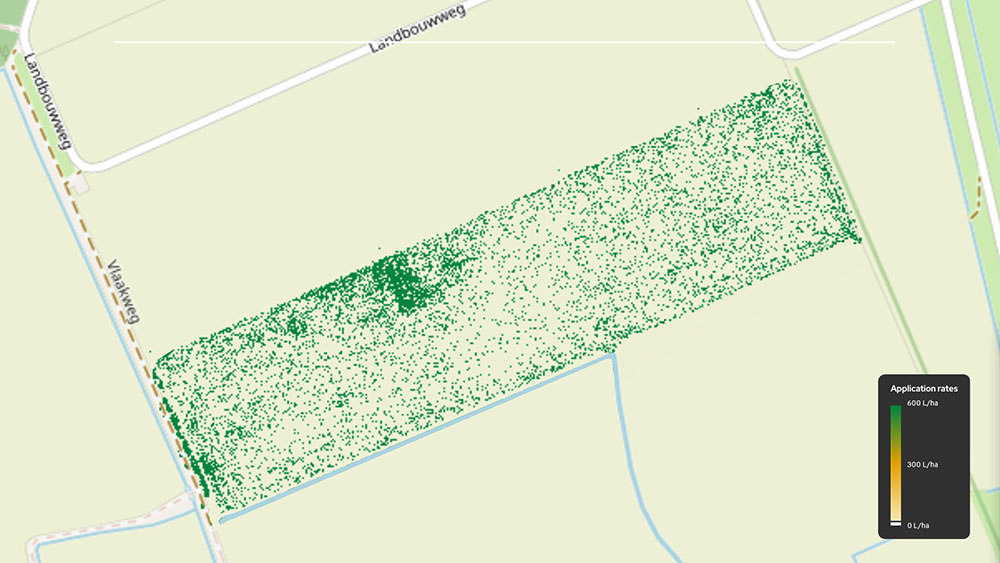
Prescription maps on a sprayer deliver the best results in farming situations with significant in-field variability, high-value crops, or specific, localized problems like persistent weeds or disease patches. By moving away from uniform application, you can apply exactly what’s needed, where it’s needed, optimizing inputs and improving crop health. Our technology makes this plant-level precision a practical reality for your farm. Read the overview article about using prescription maps on a sprayer
In which farming situations is it most beneficial to use prescription maps on a sprayer?
It is most beneficial to use prescription maps in fields with significant variability in soil type, pest pressure, or crop health. They are also highly effective for high-value crops where input optimization directly impacts profitability and for targeted treatments that can reduce chemical use by up to 99%. Our approach is to eliminate averages and treat every part of your field according to its unique needs.
How does field variability influence the benefits of using prescription maps on a sprayer?
High variability means a flat-rate application is inefficient, leading to over-application in some areas and under-application in others. This wastes chemicals and can harm both your crops and the environment. Our system uses high-resolution task maps—down to a 25 x 25 cm grid—to apply the exact dose needed for each specific zone. Whether it’s adjusting for soil type or targeting a patch of weeds, prescription maps turn variability from a challenge into an opportunity for efficiency.
Which crops or cropping systems gain the most from variable rate spraying with prescription maps?
High-value crops like potatoes, onions, and sugar beets, where optimizing inputs has a large financial return, benefit greatly from prescription maps. Broadacre crops also see huge savings when dealing with localized issues, such as the user who achieved a 96% reduction in herbicide use by targeting dock in grassland. Furthermore, orchards are a prime example where our Taskmap Spraying for Orchards enables tree-by-tree application, maximizing efficiency and crop health.
How do farm size and machinery affect the decision to adopt prescription maps on a sprayer?
While larger farms with diverse fields often see a rapid return on investment, the benefits of prescription maps are driven by in-field variability, not just acreage. Our LeapBox system is designed to make this technology accessible to any progressive farmer. Because the LeapBox can be installed on all brands and types of existing sprayers, you can adopt plant-level precision without the need to purchase entirely new machinery.
How can different data sources create effective prescription maps for a sprayer?
Effective prescription maps for a sprayer are created from diverse data sources, including satellite imagery, high-resolution drone scans, soil maps, and historical yield data. At BBLeap, we ensure you can easily use this data. Our LeapSpace cloud platform allows you or your crop advisor to upload task maps directly via the internet, sending them automatically to the sprayer without the hassle of USB sticks.
How can yield and soil maps be combined to generate prescription maps?
By overlaying historical yield maps with soil data (such as conductivity or zone maps), you can identify consistently high or low-performing areas. This insight is powerful for creating prescription maps for variable-rate application of inputs like liquid fertilizers or soil-applied herbicides, allowing you to address the underlying causes of yield variation and optimize nutrient placement.
In what ways can drone or satellite imagery be turned into prescription maps?
In-season imagery from satellites or drones provides a real-time snapshot of crop health and biomass. This data is ideal for creating prescription maps for the variable application of fungicides, growth regulators, or nitrogen top-dressing. For Hi-Res Spot Spraying, drone imagery can pinpoint individual weeds, creating maps that instruct our LeapBox system to spray only those specific spots, potentially reducing chemical use by up to 99%.
How are prescription maps on a sprayer applied in different cropping systems?
Prescription maps on a sprayer are applied differently depending on the cropping system, but the goal is always precision. Broadacre farms use them for managing large zones and spot spraying, orchards use them for tree-by-tree application, and row-crop systems use them for targeted spraying on or between crop rows. Our LeapBox system provides individual nozzle control, enabling this high level of precision across any system.
How are prescription maps on a sprayer used differently in broadacre cereal fields compared with row crops?
In broadacre cereals, prescription maps often guide the variable application of fungicides or liquid fertilizer across larger management zones based on satellite-derived biomass data. In contrast, row crops like onions or potatoes often leverage our high-resolution capabilities. This includes using spot spray maps to eliminate volunteer potatoes or applying different rates on the crop row versus between the rows with our Row & Pattern Spraying feature, which protects sensitive crops and saves inputs.
What adjustments are needed when using prescription maps on a sprayer in orchards?
In orchards, the focus shifts from a two-dimensional field view to a three-dimensional, tree-specific approach. Data from advanced sensors can create a task map that adjusts the spray rate for each individual tree based on its size, density, or health. Our system precisely executes these maps by controlling the nozzles as the sprayer passes each tree, ensuring every tree gets the exact treatment it needs and nothing more.
How do pattern-based prescription maps on a sprayer support systems like strip-till?
Our Row & Pattern Spraying feature is a perfect match for advanced farming systems. For strip-till, you can create a pattern to spray only on the cultivated strips, leaving the residue-covered soil untouched. We can configure up to four different spray patterns in your terminal, allowing you to easily switch and apply products only where they matter most, reducing waste and aligning with regenerative agriculture principles.
Conclusion
Using prescription maps on a sprayer is most valuable in any situation where variability exists within a field, an orchard, or even between individual plants. Whether you are managing different soil zones, targeting problematic weeds, or optimizing applications in high-value crops, task maps provide the data-driven path to greater efficiency and profitability. With our LeapBox and LeapSpace technologies, we make it possible to move beyond averages and unlock the full potential of your land by Farming on Plant Level.