




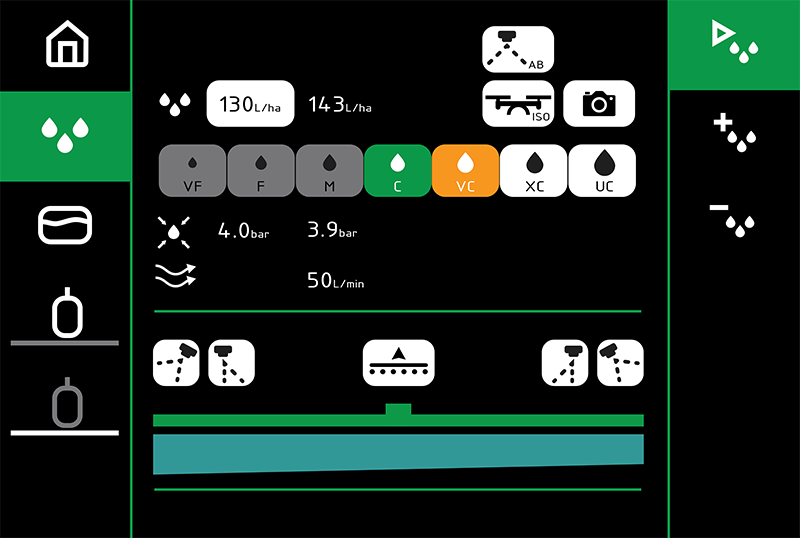
Using prescription maps on a sprayer allows you to apply a variable rate of a product, like herbicides or fertilizers, based on a pre-planned digital map. This means you apply exactly what’s needed, precisely where it’s needed, moving away from uniform application to a more intelligent, data-driven approach. This method optimizes input, improves crop health, and reduces costs. Read the overview article about Use prescription maps on a sprayer
What does using prescription maps on a sprayer for precision agriculture mean?
definitie: Using a prescription map, often called a task map, on a sprayer means instructing the machine to automatically vary its application rate based on geo-referenced data for specific zones within a field. Instead of spraying one rate across the entire field, the sprayer applies more, less, or nothing at all according to the map’s instructions, ensuring each area receives the optimal dosage.
This process transforms traditional spraying into a high-precision activity. It moves beyond simply turning sections on or off and allows for true variable rate application (VRA). With our BBLeap system, we can execute these maps with a resolution down to 25 x 25 cm, enabling genuine plant-level precision. This maximizes the effectiveness of your inputs while minimizing waste and environmental impact.
How are prescription maps defined for field sprayers?
In the context of sprayers, a prescription map is a digital file containing a grid or zones, where each cell or polygon is assigned a specific application rate. This map acts as a set of instructions for the sprayer’s control system. When loaded, the system uses the sprayer’s GPS position to identify which zone it is in and adjusts the output of the nozzles to match the prescribed rate for that exact location.
What agronomic data is used to generate prescription maps for a sprayer?
Prescription maps are generated from various agronomic data sources. Common inputs include satellite imagery showing crop health (NDVI), high-resolution drone photos identifying weed patches, soil sensor data indicating nutrient levels, or yield maps from previous harvests. You can generate these maps yourself using your farm management system or work with your crop advisor. We collaborate with numerous data providers to ensure you can easily create and use high-quality maps for spot spraying or broadacre applications.
How does a sprayer execute a prescription map in the field?
A sprayer executes a prescription map by integrating three key components: the map file, a GPS receiver for precise positioning, and a rate controller like our LeapBox system. As the sprayer moves, the GPS continuously reports its location. The terminal reads the prescription map to determine the target application rate for that specific spot. The rate controller then adjusts the flow to the nozzles in real-time to deliver that exact rate, ensuring the map is followed with high accuracy.
What file formats and data standards are needed for prescription maps on a sprayer?
The most important factor is seamless compatibility between your map source and the sprayer terminal, which our LeapSpace platform is designed to handle automatically. You can upload task maps generated by yourself or a crop advisor directly to LeapSpace via the internet, eliminating the need for USB sticks and manual file transfers. Our platform ensures the map is correctly formatted and sent directly to the sprayer.
Which prescription map file formats are most widely supported?
While industry standards like ISO-XML and Shapefiles exist, our system simplifies this for you. By integrating with leading farm management systems and data providers such as AGROMANAGER and Croptic, LeapSpace accepts maps from the tools you already use. The platform processes the file and ensures it’s ready for your LeapBox-equipped sprayer, removing any guesswork about compatibility.
How do coordinate systems and projections affect prescription maps?
Coordinate systems are crucial for ensuring the digital map aligns perfectly with the physical field. A mismatch can lead to application errors. Our integrated GPS and software solution automatically handles the necessary transformations. When you upload a map to LeapSpace and it’s sent to the sprayer, the system ensures that the map’s coordinates are correctly interpreted by the sprayer’s GPS, guaranteeing accuracy down to the centimeter.
What is the role of a task file when using prescription maps on a sprayer?
A task file, or taskdata file, is the complete package of instructions sent to the sprayer’s terminal. It contains not only the prescription map with variable rates but also metadata like field boundaries, product information, and planned routes. Our LeapSpace platform automatically bundles all this information. After the job is done, it also generates an “as-applied” map, which is a record of exactly what was sprayed where, and saves it to your account for record-keeping and analysis.
How do section and nozzle control influence prescription maps on a sprayer?
Section and individual nozzle control directly determine the level of precision and accuracy with which a prescription map can be executed by your sprayer. While basic section control can adjust rates over large areas, individual nozzle control allows for the execution of high-resolution maps, enabling true plant-level treatment. This ensures you get the maximum benefit from your data-driven maps by applying products with pinpoint accuracy.
What is the difference between section control and plant-level control with prescription maps?
Standard section control manages large segments of the spray boom, often several meters wide, as a single unit. This is adequate for simple rate changes across large zones. In contrast, our LeapBox system provides plant-level control by managing each nozzle individually. This allows you to execute extremely detailed prescription maps, such as spot spraying a single weed or varying rates on a 25 x 25 cm grid, a level of detail that is impossible with section control.
How do individual nozzle systems improve execution accuracy?
Individual nozzle systems, powered by Pulse Width Modulation (PWM), dramatically improve accuracy. Our LeapBox offers 100Hz high-speed nozzle control, allowing each nozzle to adjust its output 100 times per second. This ensures the prescribed rate is applied instantly and correctly, regardless of driving speed or turning maneuvers. This precision eliminates the over- and under-dosing common with slower, section-based systems, especially when following a complex, high-resolution map.
What happens at headlands and overlaps with prescription maps on a sprayer?
When combining prescription maps with our individual nozzle control, overlaps and headland turns are managed with maximum precision. Each nozzle automatically shuts off the instant it passes over an area that has already been sprayed or is outside the field boundary, based on its unique GPS position. This prevents the costly double application of chemicals, reduces crop damage, and ensures the variable rate plan is followed exactly, even in the most challenging parts of the field.
Conclusion
Using prescription maps on a sprayer is the key to unlocking the full potential of precision agriculture. It allows you to move beyond averages and apply inputs exactly where they are needed, reducing costs and environmental impact while improving crop health. With our LeapBox and LeapSpace technology, we make this process seamless and incredibly precise. By enabling individual nozzle control, we ensure that the detailed plans you create on a map are executed perfectly in the field, down to the plant level.